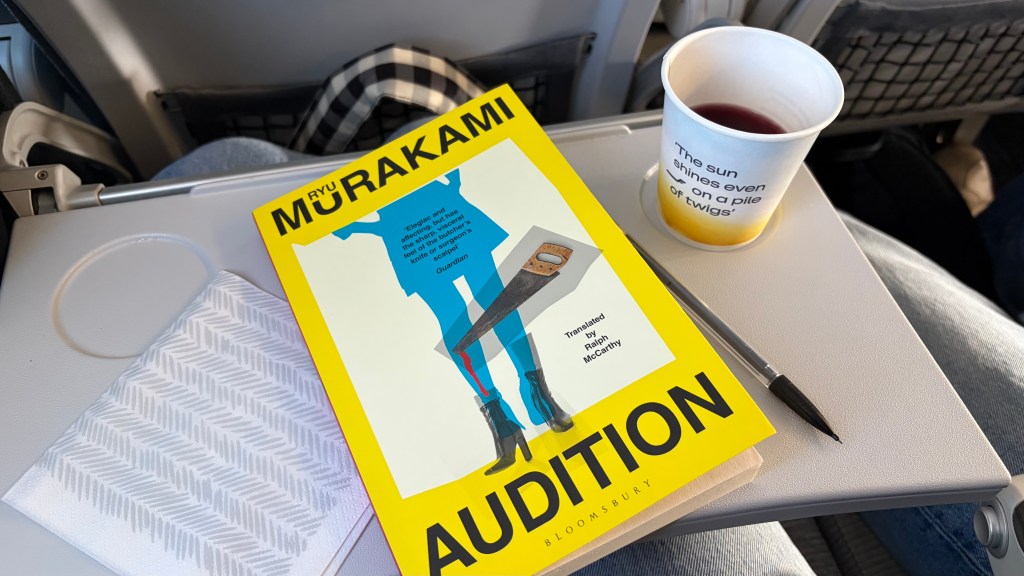
October was a busy month with an unusual amount of travel for me, but I still managed to finish 6 books, albeit short ones. I travelled to Cannes for work early in the month, which was such a whirlwind few days that I only found time to read on the flight there and back. I started out the month with Self-Help, a collection of short stories. This was followed by Hunchback and probably my favourite book of the month, Mrs Caliban. I read The Eyes Are the Best Part for my work book club and raced through Beautiful Distance before an event with the author on the 21st. I rounded out the month with my third Ryū Murakami, Audition, whilst visiting Helsinki with my boyfriend. In total I read 6 books and 888 pages.
Self-Help by Lorrie Moore
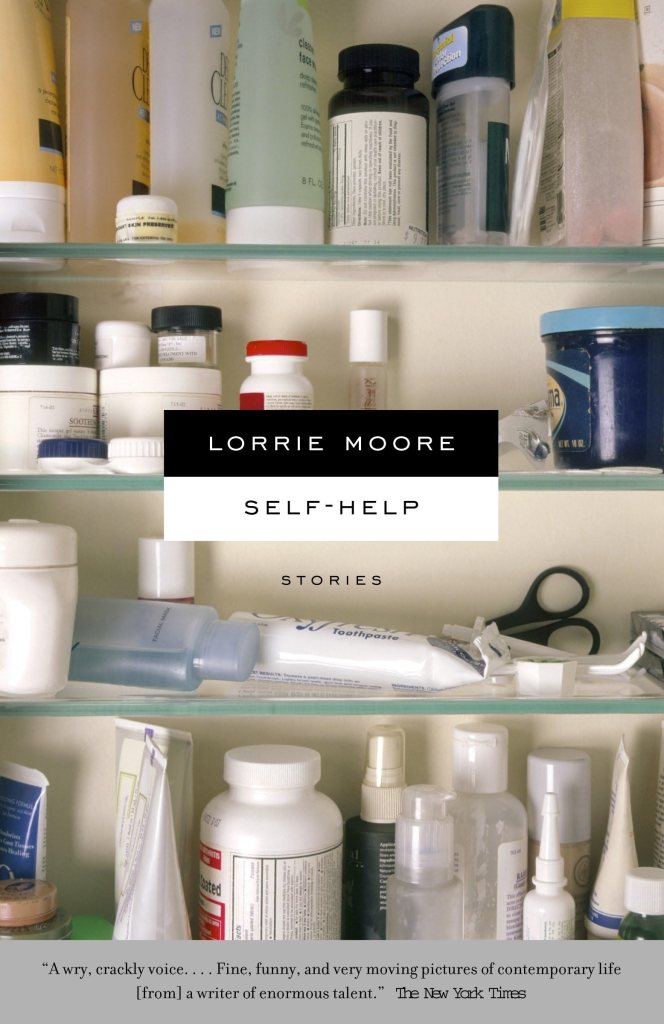
I started out the month with a book that felt aptly autumnal – if these stories were short films, they’d all be graded with that blue-green of the first Twilight film. Self-Help is the first collection of short stories from American author Lorrie Moore. Last month I read her novella Terrific Mother, and immediately wanted to dive into more of her work.
Self-Help contains nine stories of varying lengths. It opens with How to be an Other Woman, and right out the gate you’re hit with Moore’s staccato style and clever use of the second-person. As the title infers, this story explores a relationship between ‘you’ and a married man. Maybe because I recently watched How to Lose a Guy in 10 Days this feels almost like a parody of a women’s magazine article.
“Shave your legs in the bathroom sink. Philosophize: you are a mistress, part of a great hysterical you mean historical tradition. Wives are like cockroaches. Also part of a great historical tradition. They will survive you after a nuclear attack — they are tough and hardy and travel in packs — but right now they’re not having any fun. And when you look in the bathroom mirror, you spot them scurrying, up out of reach behind you.”
The second story, What Is Seized, shifts the tone to family life. A woman looks back over her childhood with the new perspective she has gained after conversations with her mother on her deathbed. This one is infused with a feeling of nostalgia, and beautiful descriptions of home remembered in retrospect.
“The rooms in our house were like songs. Each had its own rhythmic spacing and clutter, which if you crossed your eyes became a sort of musical notation, a score — clusters of eighth notes, piles of triplets, and the wooden roundness of doorways, like clefs, all blending in a kind of concerto.”
This is followed by The Kid’s Guide to Divorce and How, which tracks the course of a relationship from happiness to boredom to misery. I think you could bang a drum to the beat of this one, with the repeated phrase “a week, a month, a year” punctuating the narrative. By this point I’m starting to wonder how many of these stories will be written in this style, which I love but I’m not sure I can deal with for the full 163 pages.
“Begin by meeting him in a class, in a bar, at a rummage sale. Maybe he teaches sixth grade. Manages a hardware store. Foreman at a carton factory. He will be a good dancer. He will have perfectly cut hair. He will laugh at your jokes.”
In Go Like This, a terminally ill woman tells her friends and family that she plans to go out on her own terms. How To Talk to Your Mother (Notes) tracks a life in reverse, from 1982 to 1939, each year covered in just a paragraph or two. It’s a clever way to explore how our relationships with our parents shift over time as we and they become older.
Amahl and the Night Visitors: A Guide to the Tenor of Love might have the best opening line of any short story: “Understand that your cat is a whore and can’t help you”. This one is also structured around time, tracking the days from 30th November to 21st December through vignettes. This was one of my favourites.
My other favourite was the next story, How to Become a Writer. This also has the feel of an early 2000s magazine article. I love reading writers’ writing about writing.
“Begin to wonder what you do write about. Or if you have anything to say. Or if there even is such a thing as a thing to say. Limit these thoughts to no more than ten minutes a day; like sit-ups, they can make you thin.”
The final and longest story, To Fill, covers familiar ground at this point – infidelity and mothers. Moore is nothing if not consistent. The narrator is dealing with an unfaithful husband whilst her mother has checked herself into a catholic hospital claiming she is losing her marbles.
Every story in this collection is brilliant. I am jealous of Moore for having written them, as if I could ever write anything as good. But I did find them quite repetitive after a while, especially as the structure and subject matter were fairly similar in almost all the stories. I understand this is her first collection and captures a period of her life and writing, but I think a truly fantastic short story collection should be curated in a way that the stories can be read one after the other without feeling like you’re reading the same thing again and again. I think I would have appreciated the stories more if I’d read them over a longer period of time with other writers in between.
Hunchback by Saou Ichikawa (tr. by Polly Barton)
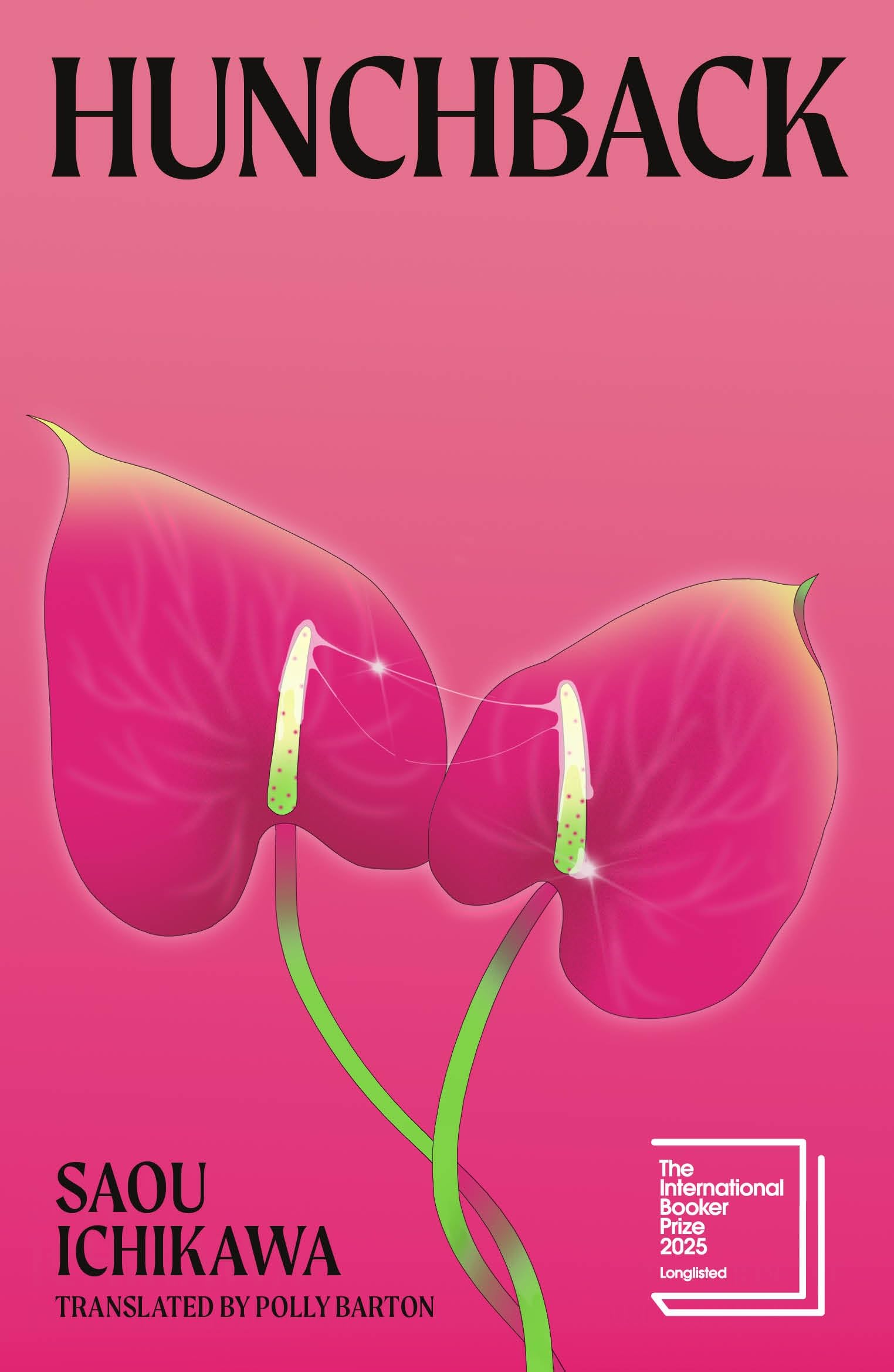
Hunchback had been on my radar since it was first nominated for the International Booker Prize this year and when a seller on Vinted had it listed alongside The Eyes Are the Best Part, I decided to give it a go. It’s a very slim volume, coming in at 97 pages, narrated by Shaka Isawa, a woman with a congenital muscle disorder which means she uses an electric wheelchair and ventilator. She lives in a group home and fills her days with writing, learning and tweeting.
Online, she shares her frustrations and desires under a fake name, as well as writing erotica on a freelance basis. One day, when all the female carers are unavailable, a new male carer comes to assist Shaka and reveals he has read everything. In response, she makes him a proposal…
It’s rare that I read a book and actually want it to be longer, but I felt I wanted more from Hunchback. I enjoyed the novella, finding it to be insightful and deliciously scandalous. I’ve seen several Goodreads reviewers complaining about how graphic it is, which I think just proves Ichikawa’s point about how physically disabled folks aren’t seen as sexual beings. Many reviewers also complained about Shaka’s desire to experience getting pregnant and having an abortion, like an able-bodied woman (knowing that she could never carry a child to term). I like that Ichikawa didn’t package up Shaka’s desires in a way that panders to an able-bodied audience.
“Of course, the tweetings of a hunchbacked monster would be more twisted than those of someone with a perfectly erect spine.”
There were also some interesting insights into ableism in the reading community and publishing industry. It really makes you realise how many aspects of privilege are at play in favouring physical books and touting their superiority. Access is more important than aesthetics.
“Here was I, feeling my spine being crushed a little more with every book that I read, while all those e-book-hating able-bodied people who went on and on about how they loved the smell of physical books, or the feel of the turning pages beneath their fingers, persisted in their state of happy oblivion.”
I would have liked to spend more time with Shaka’s character, experiencing more of her day-to-day life with her. It felt like we only just started to get to know her before the climax of the story happened. The ending is also very strange and up for interpretation, but I won’t spoil it here.
Mrs Caliban by Rachel Ingalls
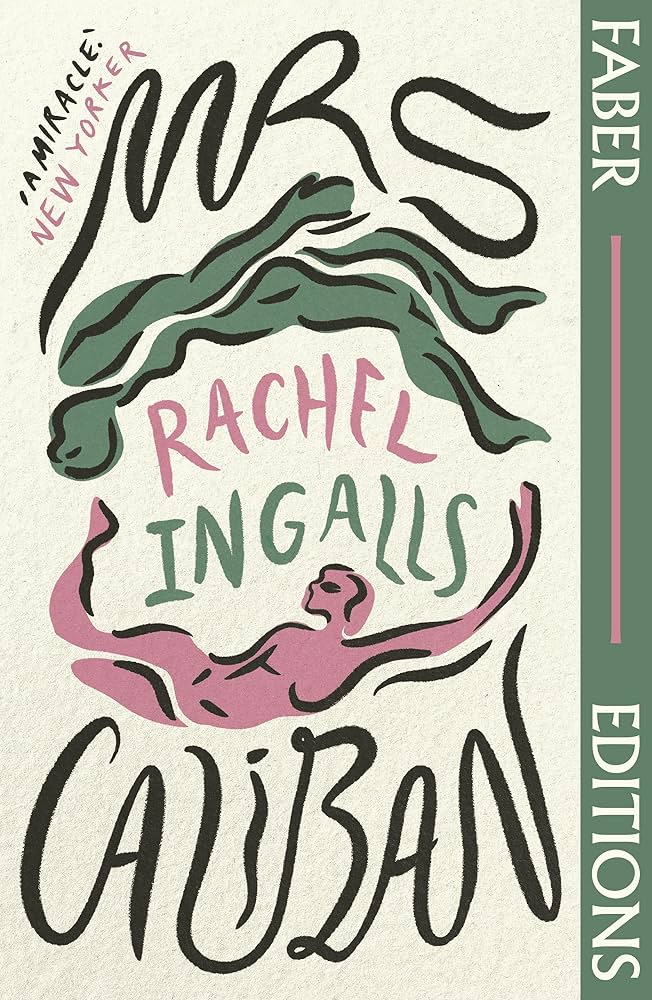
I received Mrs Caliban from my Faber Heritage Fiction subscription this month. It’s the first book they published in their Faber Editions series, which contains books that have fallen out of print and been rediscovered. As soon as it arrived in the post and I read the blurb, I knew I was going to enjoy this one.
Originally published in 1982, Mrs Caliban follows Dorothy, a Californian housewife with an unfaithful husband, who is left to mourn the loss of both their young son and unborn child alone. One day, a radio announcement warns that a green-skinned sea monster has escaped from a local research facility. When he turns up in Dorothy’s kitchen, he’s not the monster the news made him out to be, and she and ‘Larry the frogman’ soon begin an affair.
“And she was halfway across the checked linoleum floor of her nice safe kitchen, when the screen door opened and a gigantic six-foot-seven-inch frog-like creature shouldered its way into the house and stood stock-still in front of her, crouching slightly, and staring straight at her face.”
Dorothy hides Larry in her house and he is surprisingly helpful with the housework. There is a beautiful companionship between them in the domestic scenes. He is interested in learning how to do things around the house and shows deep gratitude for the meals she makes him, including his favourite: avocados.
“He concentrated on polishing spoons with a silver cloth: six teaspoons from a great-aunt. One leg was slung over the other, which would have looked strange enough, but he was also wearing a flowered apron fastened around his waist, and it contrasted stunningly with his large, muscular green body, his nobly massive head. Dorothy thought he looked, as always, wonderful.”
Larry the frogman brings hope for Dorothy. Although it’s subtle, it’s clear that Dorothy is in a very dark place before he arrives. She is dealing with grief whilst her husband becomes increasingly distant. Larry’s curiosity about Dorothy’s thoughts and feelings brings her back to life.
“There, up in the sky, she noticed for the first time a gigantic mounded cloud, as large and elaborately moulded as a baroque opera house and lit from below and at the sides by pink and creamy hues. It sailed beyond her, improbable and romantic, following in the blue sky the course she was taking down below. It seemed to her that it must be a good omen.”
I enjoyed the plot of the novel. Ingalls cleverly interwove all the characters and plot lines to create a satisfying denouement. As someone who is happy to read a beautifully written book with no plot, Mrs Caliban was a real treat with both gorgeous writing and a gripping story. Any time I had to stop reading and do something else, I was dying to know what was going to happen next in the book.
I am so glad that Faber republished Mrs Caliban and I’m grateful to have been made aware of this gem through my subscription. I don’t often read romantic novels, and whilst I’d say this is on the fringe of the romance genre, there was something magical about Dorothy and Larry’s relationship and I think it’ll be the book I think of when I think of romance.
The Eyes Are the Best Part by Monika Kim
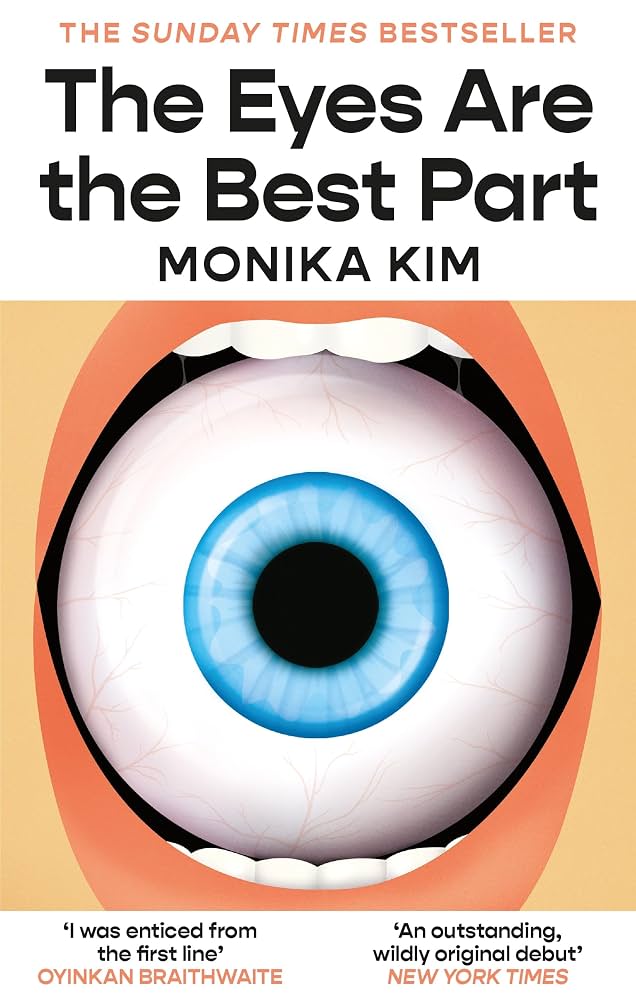
The Eyes Are the Best Part was this month’s pick for my recently established book club at work. The shortlist featured four books in the broad category of ‘spooky’ for the month of Halloween, including Don’t Go to Sleep in the Dark by Celia Fremlin, Our Wives Under the Sea by Julia Armfield and Great Granny Webster by Caroline Blackwood. When put to a vote, The Eyes Are the Best Part won by a landslide.
Monkia Kim’s debut novel follows Ji-won, a high school student whose father has recently abandoned her family for a new woman. Ji-Won’s Umma soon has a new boyfriend, George, a white man with a thinly veiled fetish for Asian women. He’s soon moved in with Umma, Ji-won, and her 15-year-old sister Ji-hyun, whom he brazenly ogles with his blue eyes.
The novel opens with a deliciously disgusting scene in which Umma encourages her daughters to eat fish eyes for good luck – they are, after all, the best part. But soon, it’s not fish eyes that Ji-won is thinking about eating, it’s human eyes. Blue ones.
“Umma takes both of her chopsticks and holds them high in the air so that Ji-hyun and I can see the small white ball positioned in between the two slender pieces of metal. She’s triumphant, her own eyes sparkling, and before either of us can stop her, she pops the entire thing in her mouth.”
From the outset I was curious as to how far the novel would go – both in terms of the horror and the social commentary. In the end, I think Kim balances the two almost perfectly. She takes Ji-won’s descent into obsession to satisfyingly gruesome depths, giving the reader the payoff they’d want from a horror novel.
“I press my tongue against the white of his sclera. It’s salty. His tears. His sweat. I can taste it all.”
But she also allows space for some really considered moments of realism and crushing commentary. It’s a story of womanhood as a Korean-American with an immigrant mother, the boxes society puts you in and punishes you for trying to escape. I revelled in Ji-won’s disgusting and brutal behaviour because it’s everything she’s not supposed to be – powerful, vulgar, angry.
“We girls are taught from an early age that we are demonstrably inferior to our male counterparts. We are smaller, weaker, stupider. When we succeed, it’s only because men allow us to. And as Asian women, we are foreign and especially powerless, with our supposedly porcelain skin, delicate physiques, “slanted pussies,” and quiet, submissive natures.”
She explores the intersection of George’s whiteness with his being a man, and how it means he can go through life with a self-assuredness and superiority that a woman, especially an Asian woman, never could. Whilst George is the epitome of this stereotype, there’s also the quietly nefarious Geoffrey, Ji-won’s classmate who spouts feminist jargon and insists he doesn’t have ‘yellow fever’. But he becomes increasingly obsessed with Ji-won and is a great portrayal of the Georges of the modern age – same intentions, different wrapper.
“By the time you’re done with him, he’ll be begging for mercy. Who is he if he can’t control you? Is he even a man anymore? It will seem like a relief when you give him a hand, even if that hand is holding a blade. And when you take everything from him, you can say what these men say about us: He was asking for it. He was begging for it. He must have wanted it, since he didn’t fight back.”
The only thing I found slightly wanting was that Ji-won’s unravelling didn’t feel like it was reflected enough in the writing. The first-person writing remained quite simple and clear throughout, despite our main character’s descent into madness. I felt sane right to the end, when I wanted to be foaming at the mouth for the eyeballs with her…
I think this was an excellent book club choice – there’s a lot to discuss and I could see the more ‘disgusting’ elements being quite divisive. Let’s see what my colleagues have to say!
Beautiful Distance by Nao-Cola Yamazaki (tr. by Charlotte Goff)
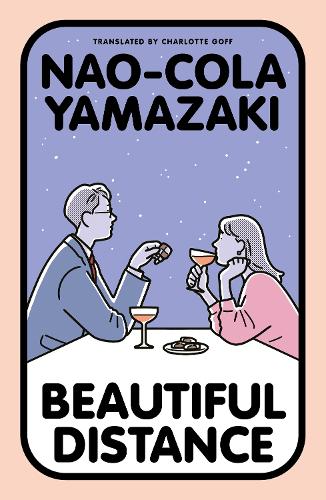
I’d seen the cute covers of Nao-Cola Yamazaki’s Beautiful Distance and Don’t Laugh at Other People’s Sex Lives in so many bookshops recently that when an event with the author at Daunt Books came up, I thought I’d give one of them a read and go to the event if I liked it. So I bought Beautiful Distance, mainly because it has a higher rating on Goodreads, and read it over a couple of days.
Beautiful Distance is told from the perspective of a man whose wife is terminally ill and living in hospital. It explores the time they spend together before her death, the ways he cares for her and the ways he brings the outside world into the hospital for her.
I found it to be a quietly moving portrait of a life lived together, even in the face of the end of that togetherness. There’s a push and pull between the narrator and his wife, an understanding of when helping her would be the loving thing to do, and when leaving her to do something herself or with the help of a professional carer would actually be the kinder thing. The way the husband was willing to do whatever his wife needed, without being overbearing in an attempt to assert his affection, was a refreshingly tender take on love at the end of life.
“I’ve decided to keep whatever care I can give to a level that won’t get in the way of the hospital staff, and that I should prioritise staying out of the way of those doing their best to care for my wife. I try not monopolise her. Being someone’s partner isn’t about keeping them all to yourself, it’s about trusting the community around them.”
Throughout the book there was an interesting commentary on how being an ill person doesn’t mean you have to be isolated from society. It can be beneficial to continue engaging with work and your colleagues even when you know you will likely never re-enter the workforce. Your profession is often part of your identity, and when you drift from other signifiers of your identity such as your home or even your normal clothes, maintaining a connection with your work can be important. The narrator comes to realise this as colleagues and suppliers from his wife’s sandwich shop come to visit her in hospital and bring out of her a passion that transcends the white hospital walls.
“I still feel a kind of social pressure to just keep my head down, focus on my treatment, and spend all my time with family. But it’s not like when I see people I’m looking for their understanding. I just want to see them. Does it really benefit anyone if people who are ill are shut up in their homes or hospitals? Is it good for society? I want to be a part of this world, even when I’m not well.”
What really got me were the small moments between husband and wife where their love for each other would shine through in their actions. The husband would help his wife with her skincare routine, which had multiple steps such as toner and serum. I was massively obsessed with skincare when I met my boyfriend, and still religiously do my multi-step routine, so this really pulled at my heartstrings because I know this is something he would do for me if I needed it.
If the above hasn’t already given it away, I really enjoyed Beautiful Distance. My boyfriend and I went to the event with Nao-Cola Yamazaki at Daunt Books Marylebone, where they were in conversation with fellow author Sharlene Teo. Nao-Cola said something really interesting about writing – that they write not for themselves but to contribute to the ‘bookshelf’. Their’s may not be the best-seller but they are part of something bigger: the bookshelf of fiction, of Japanese authors, of queer authors etc.
Audition by Ryū Murakami (tr. by Ralph F. McCarthy)
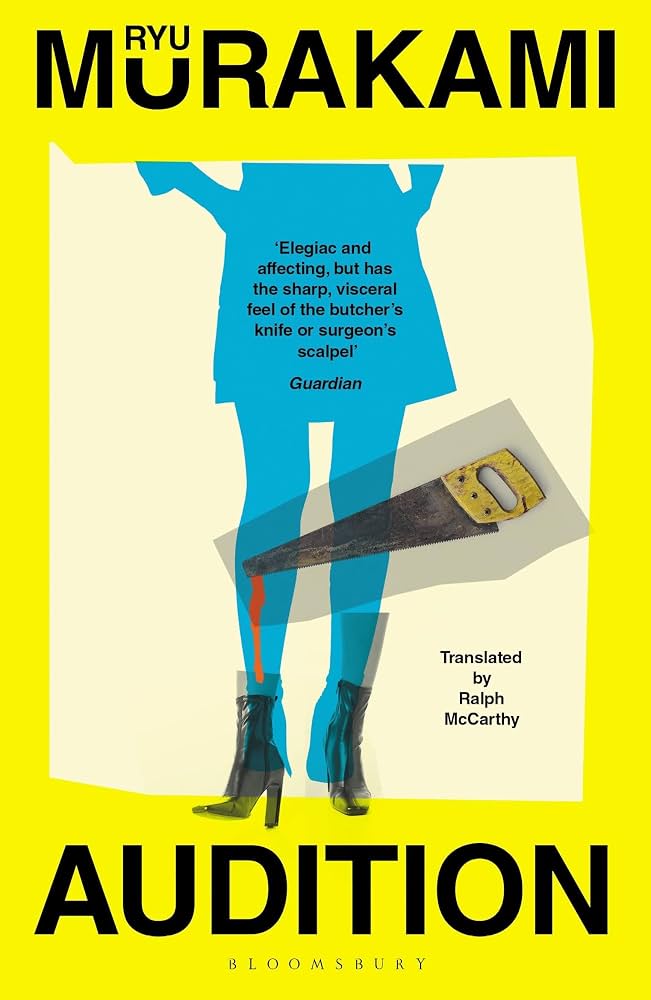
Audition is my third Ryū Murakami in two months – In The Miso Soup was so astounding that I keep coming back for more. Audition follows Aoyama, a widower who lives with his teenage son and hasn’t dated since the death of his wife seven years ago. When his son suggests he get back out there, Aoyama and his producer friend Yoshikawa hatch a plan to find Aoyama a new wife by holding auditions for a fake film.
Out of thousands of applicants, Aoyama becomes infatuated with the young Yamasaki Asami from just her CV. When he meets her, she takes his breath away and an obsession ensues. But Aoyama is so captivated by her that he ignores many red flags that point to a woman that is unstable, or maybe even dangerous…
“As if Luck, normally dispersed in billions of tiny, free-floating, gemlike particles, had suddenly coalesced in a single beautific vision – a vision that changed everything, for ever.”
Audition felt like Murakami might be making an attempt at feminism. After In The Miso Soup and 69 the bar was pretty low, but he does make some interesting observations about the dynamics between men and women and it has a general ‘good for her’ feel about it. The men were all slimy, even his teenage son at times, and I didn’t feel Murakami’s writing let them get away with it in this one. Maybe we weren’t supposed to side with Yamasaki Asami, but I certainly did.
“What husband has never speculated how free he might feel if his wife were suddenly out of the picture? And how many count the days till she takes the kids off for a week with her folks? Let these men actually lose their wives, however, and few can even summon the will or energy to run wild; it’s only then that they recognise the support system they’ve been taking for granted.”
One thing I love about Murakami’s writing is his ability to let his characters talk logistics without it ever becoming boring. Whilst Aoyama and Yoshikawa are planning the auditions and their fake film, there’s a lot of talk about how they’ll go about it and how they’ll get away with it. Murakami leaves no stone unturned and answers all the questions the reader might have so that you can strap in for the ride without any of it feeling far-fetched (although much of it is).
“Maybe having an ulterior motive is the way to go when you want to get a film made.”
Given that the book was adapted into a horror film in 1999, which is now considered a cult classic and appears on many ‘best horror movies of all time’ lists, I expected Audition to be even more graphic than In the Miso Soup. However, I found it to be a bit of a damp squib in the end. As usual, the tension and sense of unease were built up brilliantly, but I was left feeling a bit short changed by the climax.
“That’s what violence was: emotion leaking out from consciousness into the physical world, linking up with the muscles of the arms and shoulders and diaphragm and, inevitably, the face. Stifle emotion during an act of violence and the face becomes a blank, unreadable mask.”
It wasn’t my favourite Murakami, but it was still an enjoyable read and had many of the hallmarks of what I love about his writing. I’m sure I will be picking up another of his books soon.


Leave a Reply